


16
February

How Bibi Bhani Sewing Center Is Transforming Women in Northeast Punjab
Since 2024, SAF International has expanded its Bibi Bhani Sewing Centers across Northeast Punjab to equip women with employable skills and long-term income.
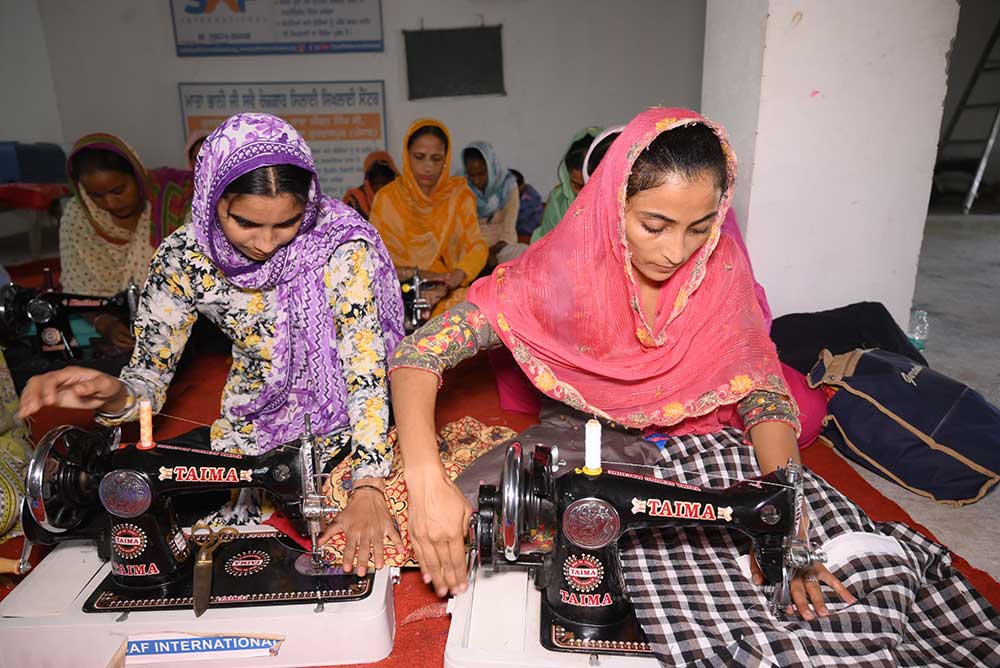
In 2024, SAF International launched its first Bibi Bhani Sewing Center near Batala, Punjab, with a simple but powerful vision: to equip women with practical skills so they could stand on their own feet — apne pairan te khade hon laayak. Rather than focusing on large enrollment numbers, we intentionally began with a small cohort of 12 young women in Dera Baba Nanak, Gurdaspur. Our goal was not scale at the start, but depth. We wanted real transformation.
One year later, that commitment to quality is clearly visible in the lives of women like Mehreen.
Mehreen’s Story: From Supporting at Home to Supporting the Household
Mehreen, 20, lives in Kot Ahmad Khan in Dera Baba Nanak. She comes from a joint family of ten members. Her father runs a small Karyana shop, but due to a non-functional arm, he is limited in the work he can perform. Although her brother is a doctor and runs a clinic, managing expenses in a large household remains challenging.
After completing her senior secondary education in 2021, Mehreen began helping her father at the shop. She wanted to contribute more meaningfully to her family’s finances, but she lacked employable skills. Like many young women in rural Punjab, she had the desire to help — but did not have the opportunity.
When her father learned about SAF International’s six-month stitching course through an acquaintance in Batala, Mehreen enrolled in the very first batch of the Bibi Bhani Ji Silayi Center.
Learning Skills and Gaining Confidence
Mehreen recalls feeling nervous on her first day. She had no prior stitching experience and doubted whether she would be able to learn. However, under the patient guidance of the trainer, Rimpy (whom they all call ma’am), and within a supportive batch environment, her hesitation gradually faded.
Over the six-month course, Mehreen learned drafting, cutting, stitching, embroidering, hemming, and creating garment samples from scratch. What initially felt overwhelming soon became manageable through structured training and daily practice. Beyond technical skills, the center fostered confidence. Trainees were encouraged to speak clearly, interact with customers, and believe in their own ability to deliver quality work.
The bonds formed within the batch continue even after graduation — reflecting the familial environment intentionally cultivated at the center. Most of the Alumni speak to each other and it’s like their mini-network, helping one another.
From Training to Income
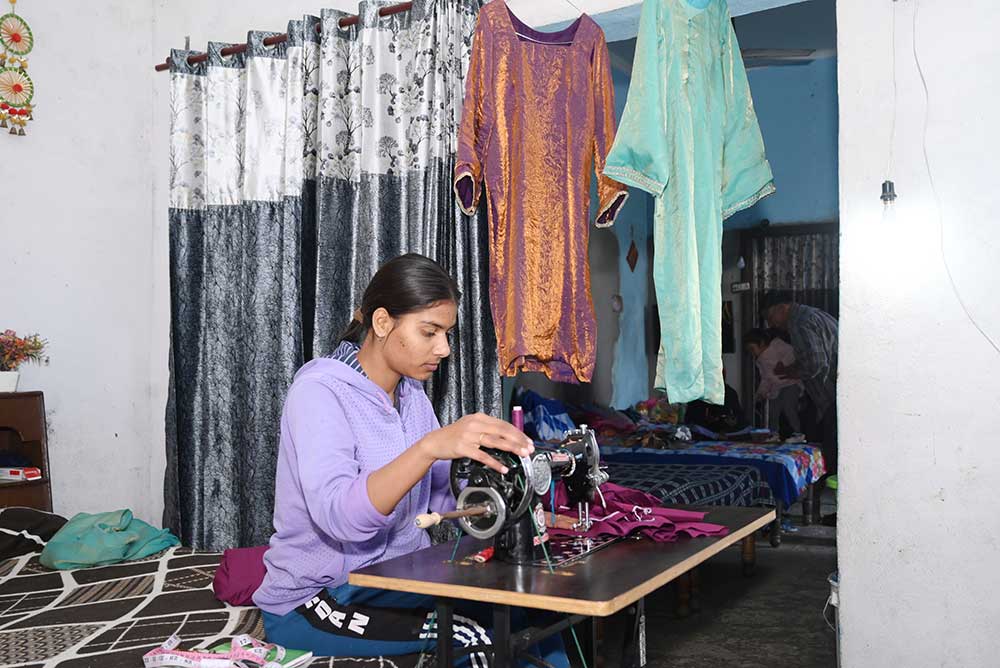
Today, Mehreen is able to stitch various styles of women’s suits, including Afghani, Dhoti, and Basic designs, as well as children’s clothing. She receives regular stitching orders from neighbours and relatives and now earns approximately ₹4,000–₹5,000 per month.
More importantly, she contributes nearly ₹4,000 directly to household expenses. For a young woman who once only assisted at home, this represents a meaningful shift. Her earnings ease the financial burden on her father and strengthen the stability of the household.
Women in her neighbourhood now choose her services over local boutiques — a quiet but powerful sign of respect and recognition.
Expansion Across Northeast Punjab
The success of the first Bibi Bhani Sewing Center affirmed the need for structured skill development programs in the region. In 2025, we expanded to establish a second center. In 2026, two additional centers were launched, bringing the total to four operational Kendars across Northeast Punjab.
Each center runs a six-month training cycle focused on quality instruction. Upon completion, graduates receive a sewing machine through our Gifts of Compassion initiative, enabling them to begin earning immediately.
This model ensures that training leads directly to livelihood.
You can see the first center in action here:
Why Women’s Skill Development Matters
When a woman gains an employable skill, the impact extends beyond her individual income. Household stability improves, children’s futures strengthen, and confidence reshapes identity. Economic empowerment is not simply about money — it is about dignity, participation, and long-term resilience within families and communities.
Mehreen now hopes to open her own boutique in the future and dreams of building a name for herself, even among women living abroad. Her journey reflects what becomes possible when opportunity meets determination.
The Bibi Bhani Sewing Centers are part of SAF International’s long-term approach to sustainable development in Punjab, India. Mehreen’s story shows that when women are given skills, tools, and support, they do not merely survive — they progress.
Support a Woman’s Journey to Self-Reliance
When you provide a sewing machine, you are not giving a gift — you are enabling income, dignity, and long-term stability.
More Stories

 December 24, 2024
Empowering Lives Through Dasvandh: Fatima and Seema’s Journey with SAF International
Empowering Lives Through Dasvandh: Fatima and Seema’s Journey with SAF International As a Sikh, I hold the principle of Dasvandh—sharing…
 February 13, 2026
A medical graduate’s journey from poverty to stability
Some stories show what hardship looks like. Mehakpreet’s story shows what resilience can become – when Sangat stands with a…
 November 24, 2024
Impact of Child Sponsorship: Sahil’s Journey of Resilience and Hope
In the heart of India’s bustling towns, stories of resilience and hope often go untold. One such story is that…